

.png)
The 10th National Assembly rose for its statutory annual recess on 23rd July 2026, barely weeks after returning from its end-of-legislative-year break, which itself came only weeks after the Salah and Easter recesses. By AdvoKC Foundation's analysis, this pattern means the National Assembly has now spent more of the legislative calendar on recess than in active plenary, when Nigerians are contending with record insecurity, a currency in free-fall, and a cost-of-living crisis that touches nearly every household in the country.
This is not a technical or ceremonial complaint. It is a question of whether the institution constitutionally charged with lawmaking, oversight, and appropriation is actually doing its job.
The 10th Assembly carries the highest budget in Nigeria's legislative history, yet the correlation between funding and floor time has moved in the wrong direction. Nigerians are entitled to ask a simple question: what, exactly, are lawmakers being paid record sums to do, if not to legislate and sit in session? Recess is a legitimate and necessary feature of any functioning parliament; lawmakers need time for constituency engagement and committee work, but recess is not supposed to be the default state of the legislature, with plenary as the exception.
Insecurity across the North-West, North-Central, and parts of the South continues to displace communities and claim lives. Inflation continues to erode household purchasing power. Public trust in state institutions is already fragile. Against that backdrop, a legislature that is more often away from Abuja than in it sends an unmistakable signal about where its priorities sit.
AdvoKC's concern is not limited to the frequency of recess; it extends to the National Assembly's active resistance to public scrutiny of its own attendance.
On 19th June 2026, AdvoKC Foundation submitted a Freedom of Information (FOI) request to the Clerk to the National Assembly, seeking attendance, absence, apology, and voting-participation records for both chambers covering the first three legislative years of the 10th Assembly (June 2023 - June 2026). The request was formally acknowledged by the Clerk's office the same day.
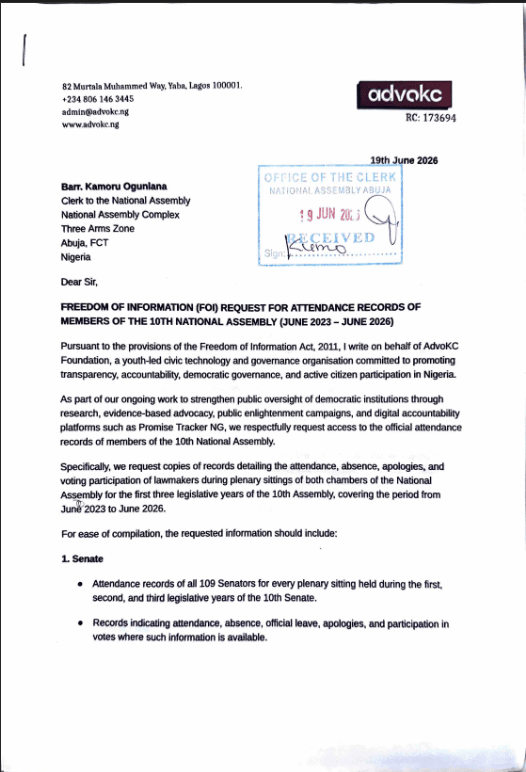
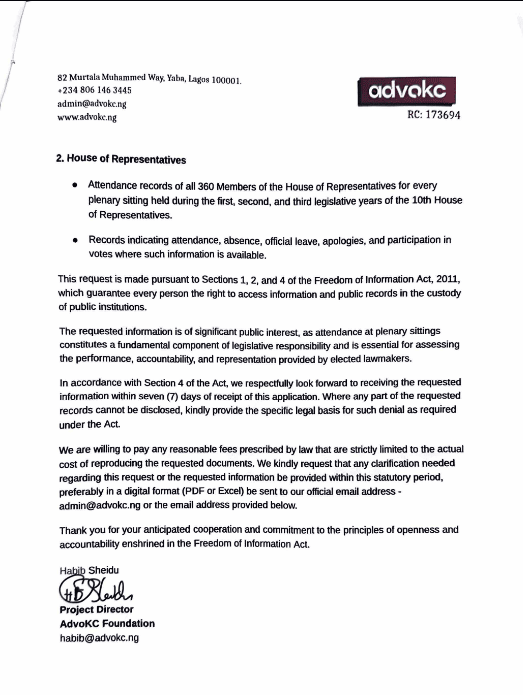
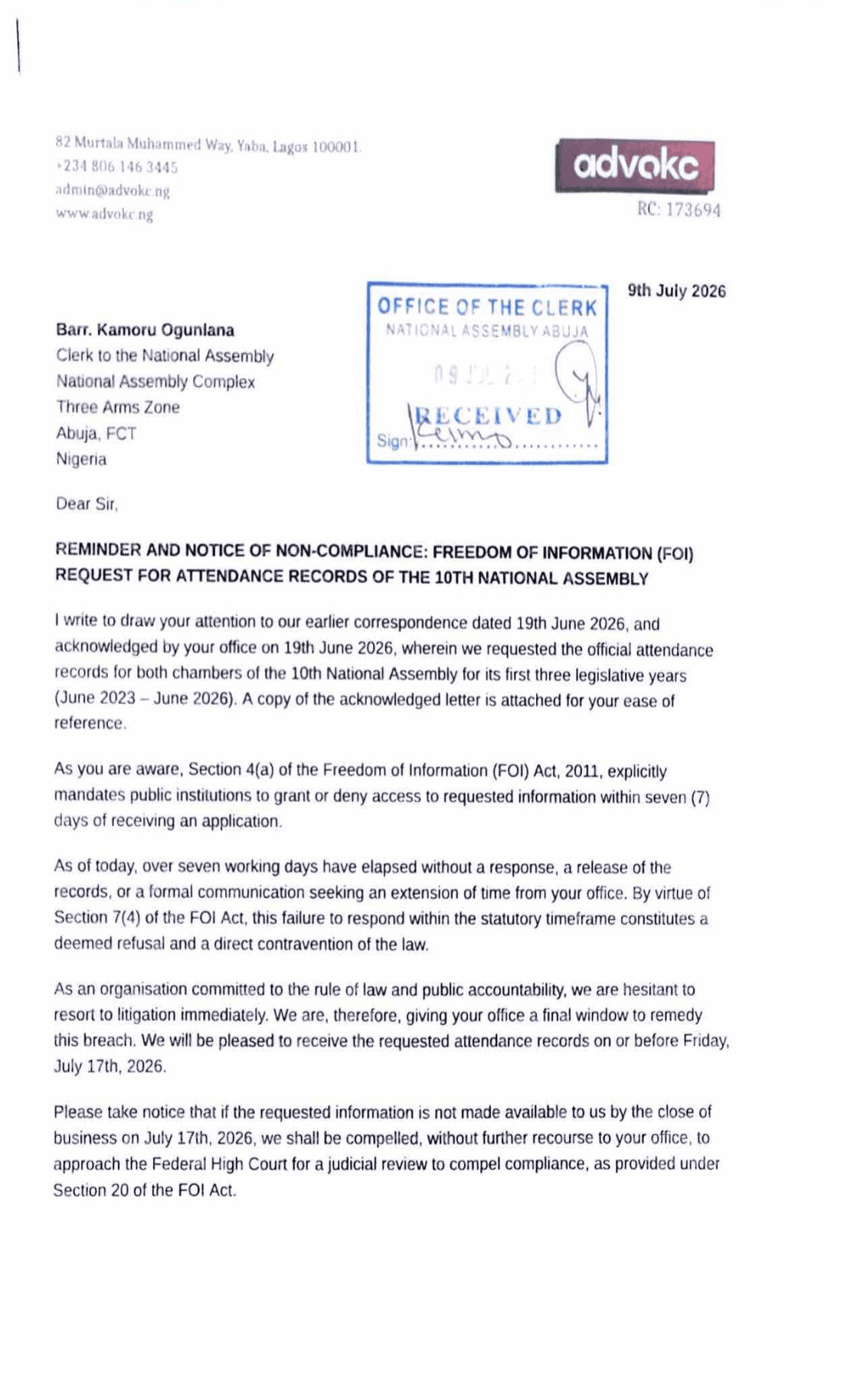
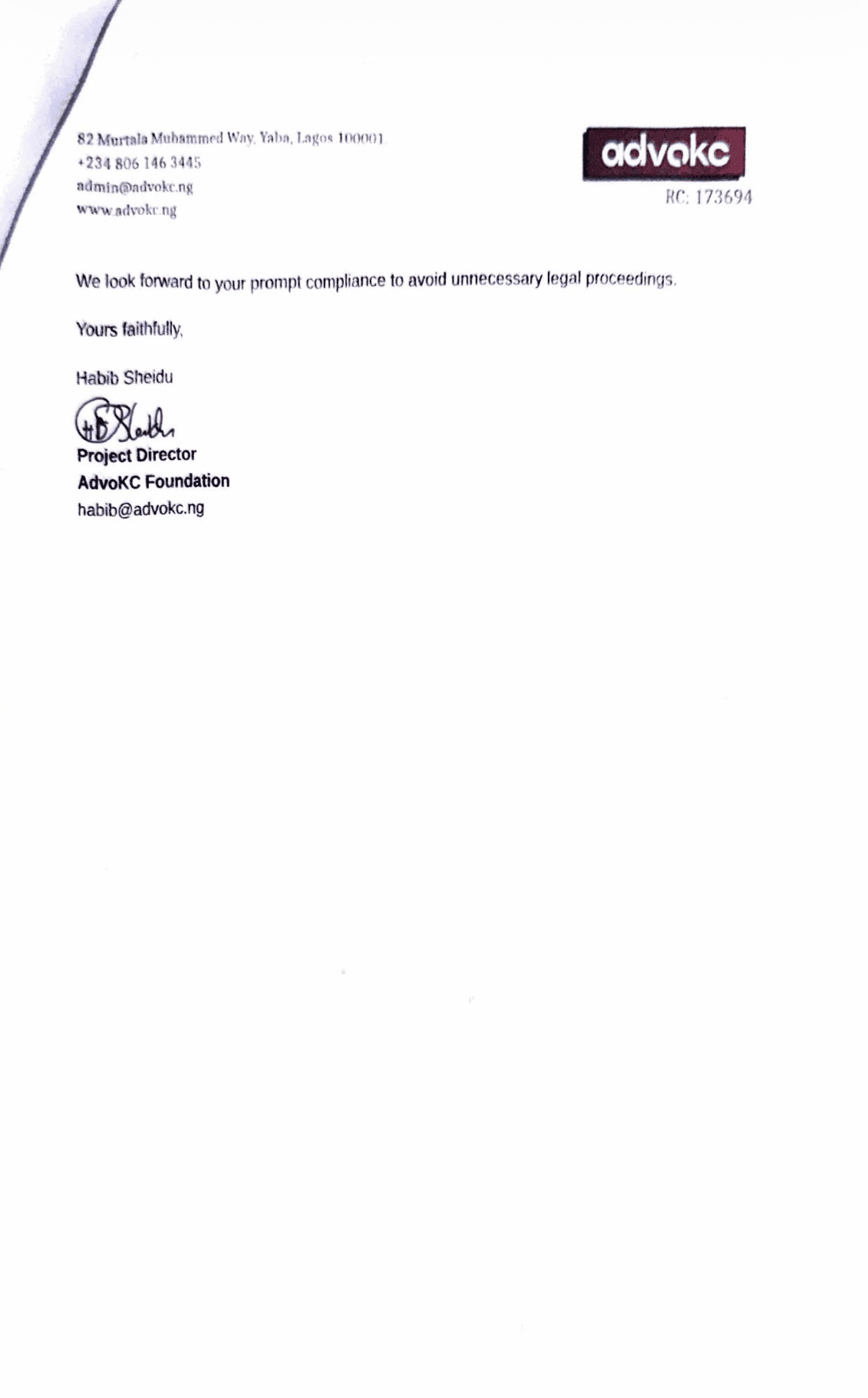
Section 4 of the FOI Act, 2011 obligates public institutions to grant or deny such requests within seven days. That deadline came and went, and on 9th July 2026, AdvoKC issued a formal Notice of Non-Compliance, warning that the failure to respond within the statutory window amounted to a deemed refusal under Section 7(4) of the Act, and set a final compliance deadline of 17th July 2026 before judicial review would be pursued under Section 20.
On 24th July 2026, a full week after that deadline, and only after the threat of litigation, the National Assembly's Legal Services Directorate finally responded. Its answer: the records could not be released because they constitute "evidence of proceedings" of the legislature, privileged under Section 16 of the Legislative Houses (Powers and Privileges) Act, 2017 and Section 16 of the FOI Act, 2011, and releasable only with the express authorisation of the Senate President, the Speaker of the House, or the relevant Committee Chairman.
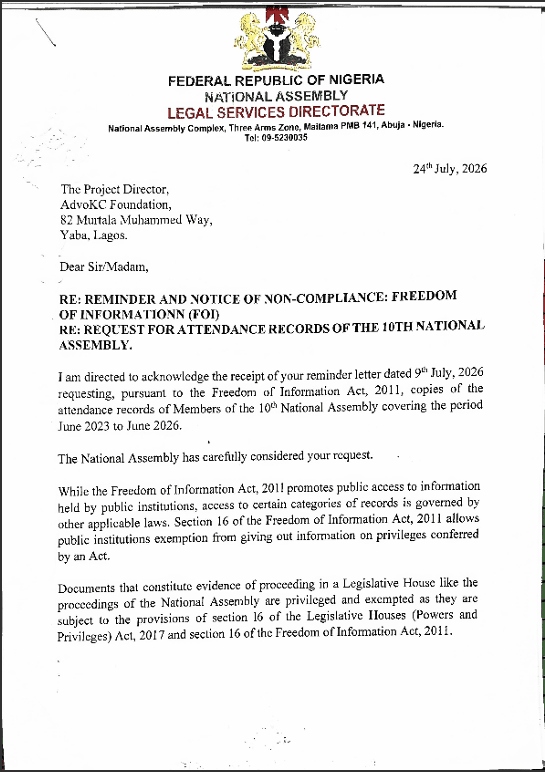
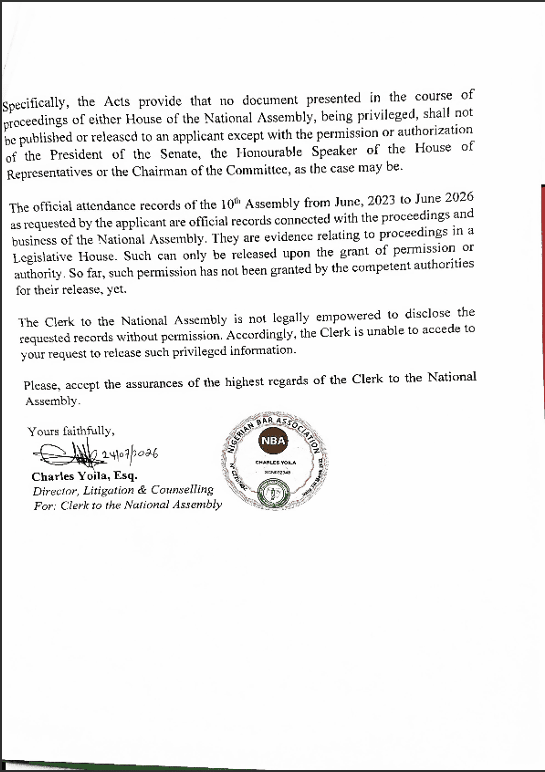
This response does not withstand scrutiny. The privilege contemplated under Section 16 of the Legislative Houses (Powers and Privileges) Act exists to protect the integrity of legislative debate and deliberation, the substance of what is said and decided on the floor, not the administrative fact of whether a lawmaker was present to say or decide anything at all. Attendance is not a record of parliamentary opinion, negotiation, or deliberative content. It is a roll call. Treating it as a privileged proceeding stretches a doctrine designed to protect free debate into a shield for basic accountability.
There is also a structural irony that should not be lost on the public: the National Assembly is asking the public to trust that the Senate President and the Speaker, the very officers whose institutions and, in many cases, whose own attendance records are implicated, should be the ones to decide whether those records ever see the light of day. That is a veto vested in the people with the least incentive to grant it.
Nigeria's courts have consistently read the FOI Act as a disclosure-favouring statute, in which exemptions are to be construed narrowly, and the burden rests on the public institution to justify withholding, not on the citizen to justify asking. A blanket, permission-gated refusal (issued only after a legal threat and a missed deadline) is difficult to reconcile with that standard.
Read together, the recess pattern and the FOI refusal tell a single, coherent story: an institution that is increasingly comfortable being seen without being scrutinised. A legislature can survive public criticism of its schedule. What it cannot survive, if it wishes to retain legitimacy, is a reputation for actively concealing the most elementary evidence of whether its members show up to work.
AdvoKC Foundation and promisetracker.ng exists precisely because Nigerians deserve tools to independently verify elected officials’ performance rather than rely on the Assembly's own account of itself. A refusal to release attendance data does not stop that work; it simply confirms why the work is necessary.
AdvoKC Foundation Demands:
AdvoKC Foundation will proceed to explore judicial review under Section 20 of the FOI Act to compel compliance, and will continue to track and publicise this matter through PromiseTracker.ng until the records are released.
Nigerians are not asking the National Assembly to explain its politics. They are asking it to confirm whether it showed up.
